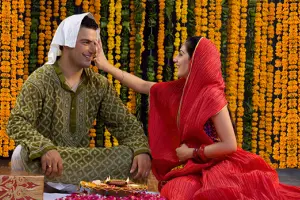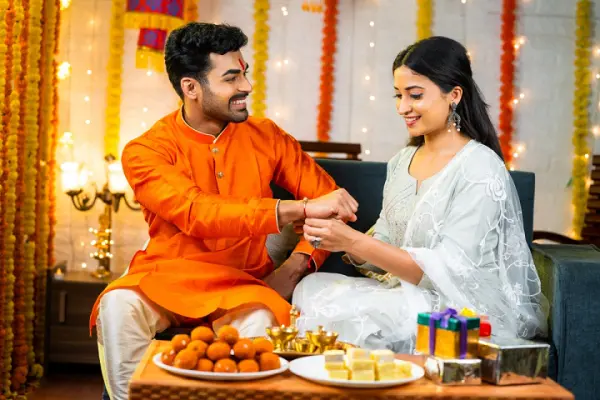
Raksha Bandhan, meaning "the bond of protection", is one of the most significant Hindu festivals honoring the special bond between siblings. Traditionally, sisters tie a Rakhi (a sacred thread) on their brothers’ wrists, wishing them well-being and longevity, while brothers promise to protect their sisters and offer gifts. The festival transcends biological relations, with people tying Rakhis to friends, mentors, and even soldiers as a mark of respect.
Also Known As: Rakhi, Rakhi Purnima, Saluno, Kajari Purnima, Narali Purnima (in some regions)
Strengthening Sibling Bonds:
The festival emphasizes love, duty, and lifelong commitment between brothers and sisters.
Historical & Mythological Significance:
Krishna & Draupadi: When Lord Krishna injured his finger, Draupadi tore a piece of her saree to bandage his wound. Touched by her gesture, Krishna promised to protect her, fulfilling it during the disrobing episode in the Mahabharata.
Rani Karnavati & Humayun: Rajput queen Rani Karnavati of Mewar sent a Rakhi to Mughal Emperor Humayun, seeking his help against Bahadur Shah. Moved by the gesture, Humayun came to her aid.
Yama & Yamuna: The river goddess Yamuna tied a Rakhi to her brother Yama (God of Death), who was so pleased that he granted her a boon of immortality for all brothers who receive a Rakhi from their sisters.
Raksha Bandhan is a one-day festival observed with rituals, prayers, and family gatherings.
The sister applies a tilak (vermilion) on her brother’s forehead, ties a Rakhi around his wrist, and prays for his long life.
The brother gives gifts (clothes, jewelry, money, sweets) and promises lifelong protection.
Many sisters also tie Rakhis to cousins, friends, neighbors, and even community protectors like soldiers and policemen.
Families gather for a festive meal, and sweets like Rasgulla, Kaju Katli, and Laddoo are distributed.
Women tie Rakhis to spiritual leaders, national leaders, and even the Prime Minister as a gesture of goodwill and national unity.
In some places, Rakhis are tied to cows, trees, and rivers as a sign of environmental protection.
Raksha Bandhan is widely celebrated across India, with regional variations:
North India (Uttar Pradesh, Rajasthan, Delhi, Punjab, Haryana, Madhya Pradesh): Grand family celebrations, Rakhi fairs, and gift exchanges.
Western India (Maharashtra, Gujarat): Alongside Raksha Bandhan, Narali Purnima is observed by fishermen who offer coconuts to the sea.
Eastern India (Bihar, West Bengal, Odisha): Celebrated with traditional sweets and rituals.
South India (Tamil Nadu, Kerala, Karnataka, Andhra Pradesh): Less elaborate, with families following simplified customs.
Nepal: Celebrated as Janai Purnima, where Hindu men change their sacred threads.
Bhai Dooj – Similar sibling festival celebrated after Diwali.
Kajari Purnima – Agricultural festival in Central India, coinciding with Raksha Bandhan.
Narali Purnima – Coastal communities' festival, thanking the sea gods for protection.
Shravani Upakarma – Brahmins renew their sacred threads on this day.
Raksha Bandhan is a festival of love, protection, and traditions, celebrating the eternal bond between siblings.
Raksha Bandhan follows the Hindu lunisolar calendar and falls on the Purnima (full moon) day of the Shravana month.
As per the Gregorian calendar, it usually falls in August.
In some regions, it coincides with Narali Purnima (a festival of coastal communities) and Kajari Purnima (celebrated by farmers).
| By Type | Festival , Cultural Festivals , Hindu Festivals |
|---|---|
| By Scale | National |
| By Duration | Single-Day |
| By Frequency | Yearly |
⚠️ This content may be AI-generated and could contain misinformation. If you notice any issue or want to suggest edits, please let us know.