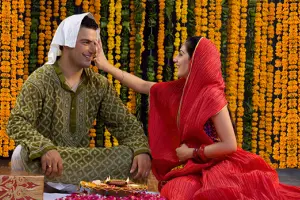
Chhath is one of the oldest Hindu festivals, mentioned in Rigveda and Mahabharata, where Draupadi and the Pandavas performed Surya worship. It is a festival of devotion, gratitude, and discipline, dedicated to Surya Dev (Sun God) and Chhathi Maiya (Goddess of Well-being & Offspring).
Also Known As: Surya Shashthi, Dala Chhath
Worship of the Sun God:
Surya Dev is considered the source of life, energy, and healing.
Offering Arghya (water oblation) at sunrise & sunset is believed to bring prosperity, good health, and longevity.
Chhathi Maiya & Child Blessings:
Devotees, especially women, pray to Chhathi Maiya for the well-being of children and family.
The festival is linked to fertility, protection, and nourishment.
Scientific & Yogic Connection:
Chhath rituals enhance immunity, detoxify the body, and improve mental discipline.
Fasting and sun exposure help in the production of Vitamin D and energy regulation.
Chhath is a four-day festival with strict rituals, fasting, and prayers.
Devotees bathe in rivers (Ganga, Koshi, Karnali, etc.) and consume only satvik (pure) food after offering prayers.
The meal includes kaddu (pumpkin), dal, and rice cooked on a clay stove with mango wood.
A 24-hour Nirjala (waterless) fast begins.
In the evening, a special prasad of jaggery kheer, chapati, and bananas is prepared and offered to Surya Dev & Chhathi Maiya before being consumed by the devotee.
This marks the beginning of strict discipline and purity for the main rituals.
Fasting continues without water.
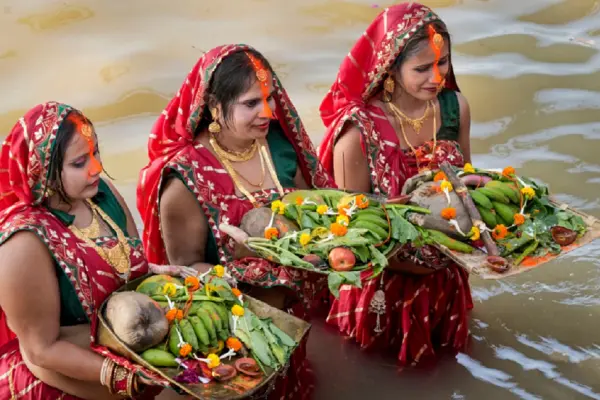
Devotees gather at riverbanks or ponds and offer Arghya (water and milk) to the setting sun, standing in water.
The prasad includes Thekua (a deep-fried wheat sweet), fruits, sugarcane, coconut, and rice laddus.
The atmosphere is filled with devotional songs and folk music.
Before sunrise, devotees return to the water to offer Arghya to the rising sun, completing their vows.
The fast is broken by eating Prasad and distributing it among family and neighbors.
Devotees express gratitude for the Sun’s energy and blessings.
Bihar & Jharkhand – The grandest celebrations, especially in Patna, Gaya, Bhagalpur, Ranchi.
Uttar Pradesh – Celebrated in Varanasi, Allahabad (Prayagraj), Gorakhpur, Lucknow.
Delhi, Mumbai, Kolkata, & Gujarat – Observed by Bihari & UP migrant communities.
Nepal (Madhesh Province, Kathmandu, Pokhara) – Major celebrations among Maithili and Bhojpuri communities.
Diwali – Chhath takes place six days after Diwali.
Makar Sankranti – Also involves Surya Dev worship and holy dips.
Chaiti Chhath – Similar Chhath in March-April (Chaitra month).
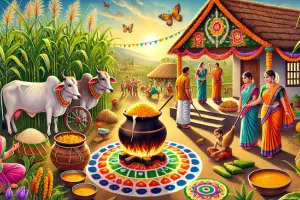
Pongal – Sun worship festival in Tamil Nadu.
Ratha Saptami – A Sun festival in Andhra Pradesh & Karnataka.
Chhath follows the Hindu lunisolar calendar and falls on the Shashthi (sixth day) of the Shukla Paksha (waxing phase) in the Kartik month.
As per the Gregorian calendar, it falls in October or November, six days after Diwali.
A similar Chhath is also observed in Chaitra month (March-April), called Chaiti Chhath.
| By Type | Hindu Festivals , Harvest Festivals , Cultural Festivals , Festival |
|---|---|
| By Scale | National |
| By Duration | Multi-Day |
| By Frequency | Yearly |
⚠️ This content may be AI-generated and could contain misinformation. If you notice any issue or want to suggest edits, please let us know.