
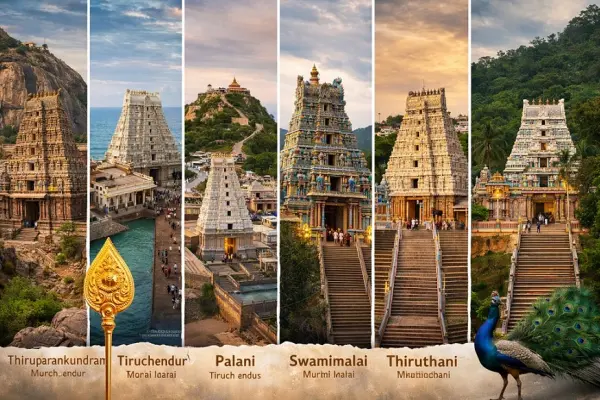
The Arupadai Veedu refers to the six holy abodes of Lord Murugan (Kartikeya), one of the most widely worshipped deities in South India, especially in Tamil culture. These temples are not random shrines—they are directly connected to different stages and events in Murugan’s life, particularly his role as a warrior and teacher.
All six temples are located in Tamil Nadu, and together they form a well-defined pilgrimage route. Devotees often visit all six temples as part of a spiritual journey, similar in importance to Jyotirlingas or Char Dham circuits in other regions.
Each temple has its own identity—some are on hilltops, some near the sea, some inside rock-cut caves—and reflect a mix of Tamil traditions, Dravidian architecture, and strong local rituals.

A forest-surrounded hill temple near Madurai, known for its natural setting and as the last of the six abodes of Lord Murugan.
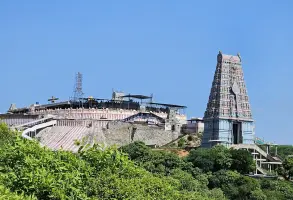
A sacred hilltop Murugan temple known for its peaceful setting and as one of the six holy abodes of Lord Murugan.

A rock-cut Murugan temple near Madurai, known as the sacred site of Lord Murugan’s divine marriage.
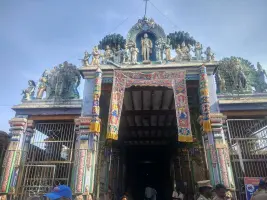
A sacred hill temple where Lord Murugan is worshipped as the teacher of Lord Shiva, and one of the six holy abodes of Murugan.
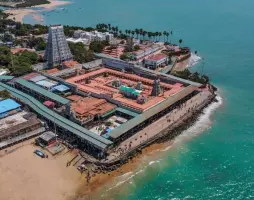
A major seaside Murugan temple, uniquely located on the Bay of Bengal and known as one of the six sacred abodes of Lord Murugan.
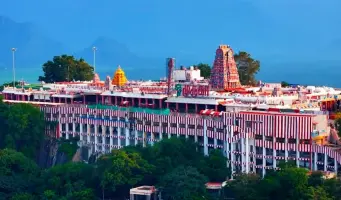
One of the six sacred abodes of Lord Murugan, set on a hill in Palani and visited by millions of devotees every year.
The Arupadai Veedu temples are not just religious sites but also reflect Tamil identity, literature, and regional traditions. Covering all six usually requires 4–6 days of travel across Tamil Nadu, and the route naturally connects cities like Madurai, Tiruchirappalli, and Kumbakonam.