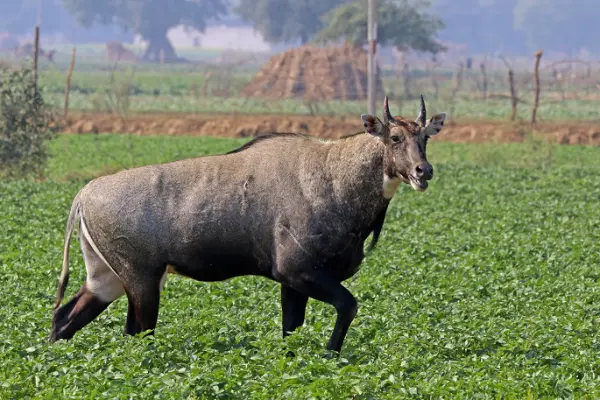
The Nilgai (Boselaphus tragocamelus), often called the Blue Bull, is the largest and most commonly seen antelope in India. Found across grasslands, scrub forests, and agricultural fields, the Nilgai is a sturdy, deer-like mammal with a blue-gray coat in males and a brownish hue in females. Males also have short, conical horns, while females lack them altogether.
The name Nilgai means "blue cow" in Hindi, referring to the bluish coat of adult males. Despite being an antelope, its cow-like appearance and religious significance in Hindu culture have largely protected it from hunting, although human-wildlife conflicts have increased due to crop damage. Travelers exploring India’s national parks, wildlife sanctuaries, and rural landscapes will often encounter Nilgai grazing in open fields or moving in small herds.
Unlike tigers or elephants, Nilgai are not difficult to spot—they are widespread across North and Central India, often found even outside protected reserves. Wildlife lovers and photographers can easily observe these majestic animals in their natural habitat, especially in grasslands, dry forests, and agricultural zones.
Another fascinating aspect of Nilgai is their role in India’s ecosystem. They are herbivores that help maintain grassland health by grazing, and their presence indicates a well-balanced environment. They are also fast runners, reaching speeds of up to 50 km/h, and have an interesting defense mechanism—freezing in place when they sense danger, making them appear invisible to predators.
Yes! Nilgai are among the most commonly sighted large mammals in India. Unlike many other wildlife species, you don’t always need to visit a national park to see them—they are often spotted in farmlands, near highways, and at the edges of forests. However, for the best wildlife experience, here are some great places to see Nilgai:
| By Behavior & Lifestyle | Herbivores & Grazers , Fast Runners |
|---|---|
| By Geographic Region | Desert Wildlife |
| By Natural Habitat | Terrestrial Species , Grassland Species |
| By Type | Herbivores |
⚠️ This content may be AI-generated and could contain misinformation. If you notice any issue or want to suggest edits, please let us know.